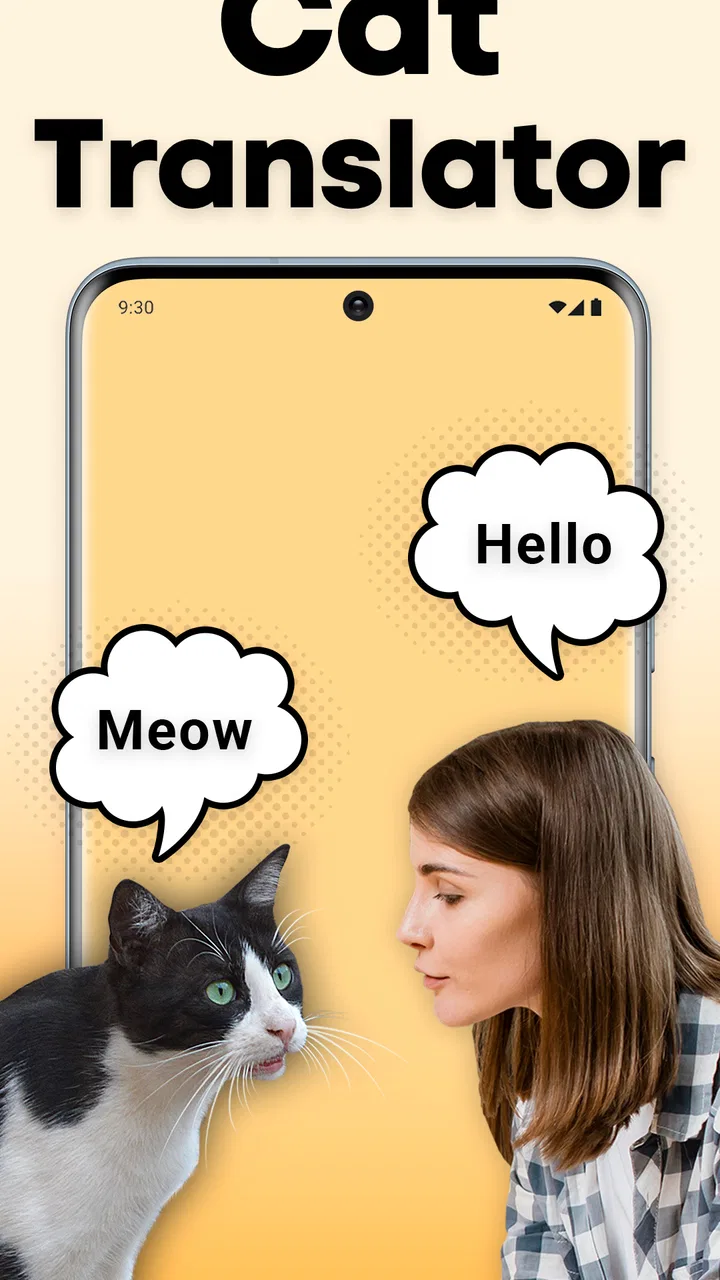
CatTranslator - Cat to Human
- 4.0
- Rating
- 1.00M
- Installs
- Free
- Price
 Analysis by App-foxy
I approached CatTranslator as a light role-playing game rather than a serious translation tool, and that distinction matters. Its appeal is the playful idea of turning a conversation between a person and a cat into a small interactive experience. I found it best when used as a shared bit of fun: you try a phrase, involve your pet, and enjoy the reaction or the joke that follows. It is not something I would open when I genuinely need to understand an animal’s health, mood, or behavior.
That simple purpose is also the game’s strongest quality. It removes pressure and gives families, children, and cat lovers an easy activity that can be picked up without preparation. The listing presents it as a human-to-cat and cat-to-human talk game, while the store’s shorter label is simply CatTranslator. In practice, I would treat those descriptions as entertainment first and interpretation second. If you keep that expectation, the experience makes much more sense.
What the playful translation idea feels like in everyday use
The most natural way to use it is during a quiet moment with a cat. Imagine sitting on the sofa after work while your pet is watching you, meowing, or wandering around the room. Instead of opening a conventional puzzle game, you can use this as a quick conversation-themed diversion. You enter the mood of speaking to your cat, let the game frame the exchange, and turn an ordinary moment into something you can share with another person nearby.
You May Also Like

 Blood Strike: 2.5 Anniversary
Blood Strike’s Loadouts Turn Every Drop Into a Tactical Gamble
A close look at Blood Strike’s custom loadouts: how fast access to signature weapons reshapes its battle royale rhythm, rewards preparation, and narrows the gap between fights.

 Pandora - Music & Podcasts
Pandora’s Music Is Easy to Start, but Harder to Recover
Pandora’s strength is its low-effort path from a seed to a station. Its weak spot is how much confidence it asks you to place in connection, setup, and quiet recovery.

 8 Ball Pool
 Is Built on Rivalries, Rematches, and Routine
A close look at the rivalries, rematches, shared routines, and unanswered safety questions that turn a quick pool match into a persistent mobile community.

 Samsung Music
’s Quiet Strength Is Playing What You Already Own
Its reach comes less from spectacle than from dependable access to a personal library. That simplicity is both the app’s strongest retention engine and its ceiling.

 AccuWeather: Weather Radar
AccuWeather Review: A Quick, Clear Forecast for Everyday Decisions
For everyday plans, the best forecast is the one you can understand quickly. AccuWeather makes rain timing, radar, and local conditions easy to act on, with a few trade-offs.

 Hill Climb Racing
Why Hill Climb Racing Still Turns Crashes Into One More Run
A tiny car, a bumpy hill and one more upgrade: Hill Climb Racing keeps resurfacing because its simple chaos makes every near-miss feel personal.
More From Our News Desk



I especially liked the social side of that setup. A child can enjoy pretending to ask the family cat a question, while an adult can join in without needing to learn complicated controls. The game’s role-playing identity makes the interaction feel more like make-believe than a technical demonstration. That is a useful strength because it gives the app a clear reason to exist: it creates a playful ritual around a pet.
There is a subtle difference between using it alone and using it with someone else. Alone, the novelty may fade more quickly because the activity depends heavily on your willingness to play along. With a friend, sibling, or child, the same exchange can become a small performance. One person speaks for the human, another interprets the cat, and the pet becomes the center of the joke. That shared format gives the game more staying power than the basic concept might suggest.
I would not approach every response as a factual statement about feline communication. Cats communicate through body language, posture, vocal patterns, routine, and context, and a casual game cannot replace observing those things. The useful mindset is to let the app inspire attention without allowing it to make decisions for you. If a cat seems frightened, sick, unusually quiet, or aggressive, real observation and professional veterinary advice are far more appropriate than any playful translation.
A simple routine that makes the game more enjoyable
My preferred approach is to use it in short sessions rather than trying to force a long conversation. Start with a familiar situation, such as a cat waiting near its food area or sitting beside a window. Make one playful exchange, watch how the animal actually behaves, and then stop if the cat loses interest. This keeps the game connected to the pet without turning the pet into a prop.
Another useful habit is to compare the game’s playful interpretation with what you already know about your cat. If the animal is purring, relaxed, and choosing to stay nearby, the real-world signals are already more valuable than any fictional message. The app works best as an extra layer of amusement placed on top of those observations, not as a replacement for them.
For children, I would set that boundary clearly. It is fine to pretend that the cat is answering, but children should also learn that a cat can move away, hide, flatten its ears, or show other signs that it wants space. This turns the game into a gentle opportunity to talk about respectful pet behavior. That is a more meaningful use than simply tapping through exchanges without watching the animal.
The game can also work as a conversation starter for people who do not normally play role-playing titles. Someone who avoids combat systems, character statistics, or lengthy stories may still enjoy a pet-centered premise. The lack of a demanding fantasy setting makes it easier to introduce at a family gathering or during a casual break. I see it as a small social toy with a role-playing wrapper, not as a deep adventure.
Where it stands among other role-playing games
Compared with a traditional role-playing game, this is much lighter. It does not ask me to build a character, manage equipment, follow a large plot, or learn a complicated world. That makes it approachable, but it also means players expecting progression, exploration, or strategic decisions may find the experience thin. A conventional role-playing title is the better choice when I want a sustained journey and a sense of achievement that develops over many sessions.
It also differs from ordinary pet simulators. A pet simulator usually focuses on caring for a virtual animal, maintaining routines, or watching a character grow. This game’s central attraction is the imagined exchange between human and cat. If your priority is feeding, grooming, decorating, or raising a virtual pet, another type of app may suit you better. If your priority is pretending to have a conversation, the translation theme is more relevant.
Finally, it should not be compared with scientific animal-behavior tools as though they served the same purpose. Educational resources can help explain feline body language and welfare, while this game is designed around amusement. I would use an educational source to learn why a cat behaves in a certain way and use this game when I want a playful activity after that. The two can complement each other, but they should not be confused.
What works well, and where the novelty starts to wear thin
The clearest strength is accessibility. The game is free to start, carries an Everyone content rating, and is available for devices running Android 7.0 or later. Those details make it easy to suggest for a broad household, especially when the goal is a harmless activity involving a cat. The developer is Tripti, and the game has attracted over a million installs, which fits its broad, easy-to-understand premise.
Its average rating is 4.1 from around sixteen thousand ratings, a sign that the concept connects with many players even if it is not universally satisfying. I would read that reception as evidence of straightforward entertainment rather than proof of accurate translation. People are likely responding to the novelty, the pet theme, and the fun of trying it with friends. That is the standard I used when judging it.
The current version is 1.9, and I found the overall idea easiest to appreciate when I did not demand a lot of depth from it. A short, focused interaction can be charming. Repeating the same style of joke too often can make the experience feel less fresh, particularly for an adult playing alone. This is the kind of game I would keep available for occasional use rather than make it part of a daily gaming routine.
The main weakness is therefore not that the premise is simple; simplicity is part of its appeal. The problem is that the concept places a heavy burden on imagination. If you are not already amused by the idea of talking with a cat through a game, there may not be enough underneath it to change your mind. Players who want clear goals, meaningful choices, or a substantial story should skip this one and choose a fuller role-playing experience.
I also think the wording around translation can create the wrong expectation. A player may open it hoping to decode a cat’s actual needs, only to discover that the experience is better understood as a playful simulation. That mismatch can lead to disappointment, especially for new cat owners looking for guidance. I would recommend reading the premise as pretend communication and relying on responsible pet care practices for real concerns.
There are in-app purchases priced from $3.99 to $19.99 per item. Because the game is free, I would try the basic experience first and decide whether the entertainment value justifies spending anything. This is particularly important here because the core appeal is novelty. A purchase may feel reasonable to someone who repeatedly shares the game with family, but less so for a person who only wants to test the idea once.
My practical advice is to avoid buying anything during the first curious session. Use the free version long enough to see whether your household actually returns to it. If children are involved, an adult should handle purchase decisions and explain that the game is optional entertainment, not a necessary tool for understanding the family pet. That approach keeps the cost aligned with real use rather than initial excitement.
Three ways to get more value from a small concept
First, use the game as an observation prompt. Before starting, notice what the cat is doing and write down the real context in your own words: resting, waiting, hiding, seeking attention, or reacting to noise. Then enjoy the fictional exchange and compare it with the animal’s actual behavior. This turns a quick game into a more thoughtful activity and helps prevent the translation theme from being taken literally.
Second, make it a turn-based group activity without treating the app like a competition. One person can invent a question, another can respond in the spirit of the cat, and everyone can watch whether the pet chooses to participate or leave. The important trade-off is that the entertainment comes from the people involved as much as from the software. If nobody wants to perform or improvise, the game will probably feel much less engaging.
Third, use it as a low-pressure introduction to role-playing. Someone who normally avoids fantasy games can try this because the subject is familiar and the stakes are low. Afterward, you can decide whether that person would enjoy a deeper pet simulator or a story-driven role-playing game. In that sense, this title can serve as a gentle first step, but it should not be mistaken for a full example of what the wider genre offers.
A fourth tip is to keep sessions tied to the cat’s comfort. Do not repeatedly call, touch, or disturb an animal that has moved away. The game should fit around the pet’s routine, not dictate it. That sounds obvious, but it is the difference between a pleasant family joke and an irritating experience for the animal. The best sessions are brief, voluntary, and easy to end.
Who should install it, and who should pass
I would recommend this game to cat owners who enjoy playful apps, parents looking for a simple shared activity, and casual players who want a role-playing idea without a large commitment. It is also suitable for someone who likes the humor of imagining what a pet might say. The Everyone rating supports its broad family appeal, although adults should still guide children toward respectful behavior around real animals.
It is a particularly good fit when the goal is interaction between people. A family can use it during a quiet evening, a child can show it to a parent, or two friends can compare their imaginary conversations. The game gives those moments a theme, which is often enough for a short burst of entertainment. I would not judge it by the standards of a long-form game because it is serving a smaller, more casual purpose.
I would advise skipping it if you need reliable advice about a cat’s health, emotions, or behavior. It is also a poor match for players who expect rich progression, a carefully developed narrative, or complex mechanics. People who dislike novelty-based games may find the central joke wears out quickly. In those cases, a pet-care app, an animal-behavior guide, or a deeper role-playing game would be a more sensible choice.
There is also a practical audience distinction between children and adults playing alone. Children may supply much of the imagination themselves, so the game can feel lively even when the mechanics are modest. An adult alone may need a stronger interest in the premise to keep returning. I would therefore recommend it more confidently as a shared family or social experience than as a primary game for a serious solo player.
Installation is straightforward for compatible Android devices, and the lack of an upfront price makes trying it relatively easy. Still, compatibility is not the same as suitability. Before installing, ask what you want from it: a joke with your cat, a family activity, or a genuine communication aid. Only the first two goals match the experience I would confidently recommend.
My final view after using it
CatTranslator succeeds when it stays playful. I enjoyed the idea most when I treated it as a small role-playing activity that helped people imagine a cat’s side of a conversation. Its free entry point, broad age rating, familiar subject, and simple premise make it approachable, while its popularity and 4.1 average suggest that many players find the concept enjoyable.
At the same time, I would not oversell it. The game cannot replace learning feline body language, observing a pet’s routine, or consulting a veterinarian when something seems wrong. Its novelty may also fade for players who want substantial progression or who play alone without much interest in improvisation. The in-app purchase range makes it sensible to test the free experience carefully before spending money.
My recommendation is specific: install it if you want a light, cat-themed conversation game to share with family or friends, and approach every “translation” as make-believe. Skip it if you are searching for a dependable animal interpreter or a deep role-playing adventure. Its real value is not decoding cats; it is giving people a playful reason to pay attention to them together.
FAQs for CatTranslator - Cat to Human
01What is CatTranslator - Cat to Human and how does it work?
CatTranslator - Cat to Human is an innovative app designed to interpret your cat's meows and translate them into human language. By using advanced audio recognition technology, the app analyzes the sound patterns of your cat's vocalizations, offering insights into what your feline friend might be trying to communicate.
02Is CatTranslator - Cat to Human accurate in translating my cat's meows?
While CatTranslator provides entertaining and engaging translations, it's important to note that it may not always be scientifically accurate. The app uses complex algorithms to offer interpretations, but each cat's vocalizations are unique. Therefore, use the translations as fun insights rather than definitive meanings.
03Can I use CatTranslator - Cat to Human with multiple cats?
Yes, the app is designed to work with multiple cats. You can record and analyze the meows of different cats by using the app's user-friendly interface. Simply select the cat you want to interpret, and the app will provide translations based on their specific vocal patterns.
04Does CatTranslator - Cat to Human require an internet connection?
CatTranslator primarily functions offline, making it convenient for users who may not always have internet access. However, some features, such as sharing translations on social media or receiving updates, may require an active internet connection.
05Is CatTranslator - Cat to Human safe to use for my cat?
Absolutely, the app is completely safe for both you and your cat. It only uses the microphone to record sounds temporarily for analysis. There are no harmful emissions or intrusive permissions, ensuring a secure and enjoyable experience for both you and your feline companion.
Pros
- Fun and engaging interface for cat lovers.
- Easy to use with intuitive controls.
- Offers a variety of meow translations.
- Enhances interaction with your pet.
- Regular updates with new features.
Cons
- Limited accuracy in translations.
- In-app ads can be intrusive.
- Requires internet for full features.
- May misinterpret certain sounds.
- Some features locked behind paywall.

CatTranslator - Cat to Human
Gallery